
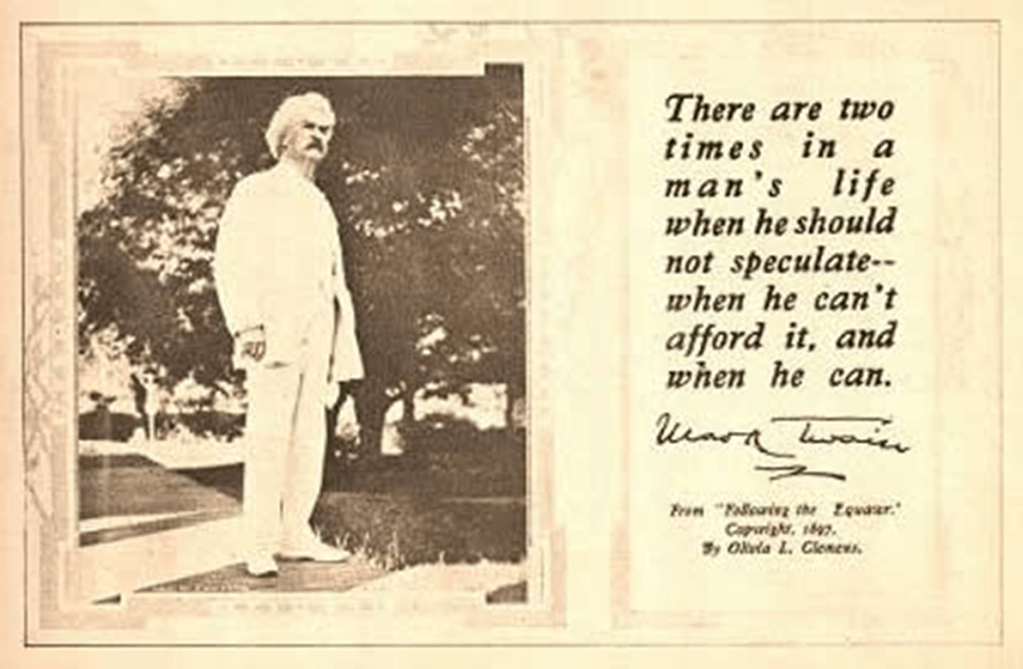
Speculating, investing and saving
Many of those who have some spare money and want to make it work for them fail to distinguish between speculating, investing and saving. They are not mutually exclusive. However, each has its own characteristics risks and rewards, which need to be understood in the context of what a person is trying to achieve. Whats going on now seems not to recognise that speculating is not investing or saving? Or am I just so old and set in my ways that I just don’t get it?
Speculating
A full-page advertisement in the FT for a trading platform has a disclaimer that gives a much starker warning than the old ‘remember that the price of your units and the income from them may go down as well as up’. It reads (really!):
“75.26% of retail investor accounts lose money when trading spread bets with this provider. You should consider whether you can afford to take the high risk of losing your money”
Well, that sounds like me at Wincanton races. But that’s more fun – a good day out with friends in the fresh air, a pastie and a couple of pints and checking odds with the bookies. But….. watching that outsider falling at the first fence and losing your fiver. That’s amateur punting for you or, if you like, speculating just like day trading.

It’s so cheap to trade whether stocks, currencies, CFDs, options or cryptos. And much less hassle than all those boring fact finds you must suffer if you want to invest in managed funds. Of course, you are certainly one of the 24.74% that makes money. Everyone has a story about a friend who made thousands on bitcoin.
But there’s more. Meme stocks, NFTs, SPACs, all new and exciting appealing to a tech savvy generation. Scams aplenty, and 75% of new internet-based companies unprofitable (and like to remain so) until they quietly disappear. Every time I look for information about finance, offers of trading jostle for top slot in the search engine. Is this what it is all about?
Investing
Understand about investing not just trading. Microsoft, Amazon, Google and others are real world services that add value to our lives. Most of us use all of them almost every day. Their share prices reflect that. Owning their shares is investing to get a future return. Some of them even pay a dividend while others need to persuade investors that reinvesting profits can generate better long term returns that they could getting dividends and investing them somewhere else. Their prices maybe too high in relation to future revenues thanks to eager FOMO investors, but if they take a tumble, because investors think they may have to wait too long to get a dividend, they still have real revenues, and they will recover in time and may even start paying dividends as they mature.
Picking future winners is not easy. If you had invested $1000 in Amazon at the time of its first public offer, your investment would be worth $2,000,000(ish) today.

Would you have invested?
But would you really have backed a guy who thought he could sell books by mail order out of a warehouse in San Francisco cheaper than bookshops? At that time, you could have received a yield of 6.5% on a US 10-year Treasury Bond, backed by the full faith of the US Federal government. So, investing is not about venture capital. Not every one is an Amazon. VC investors generally reckon that out of five investments two will go bust, two will survive and poddle along and one will be a star and pay for the losses elsewhere. Most investors don’t have the skill and ability to do this, or indeed access to a pool of start-ups or VC investments.
What an investor wants is a steady boring company that makes products that people will continue to want, sells them profitably, has sound finances and a competitive market position, and whose shares are priced at a discount to the ultimate value. Avoid fashions, like (dare I say?) ESG. In other words, be a long term value investor, like Warren Buffet. He is not always right but has a well-diversified portfolio in which winners balance losers. Not as exciting as surfing the big waves of speculative gambles, but the right way to think longer term, if you have an objective in mind which calls for deferral of pleasure. Some investments may go down and some go up in the short term. Ignore short term market fluctuations. Buffet does. If you are investing for your pension, proper value investing remains the best way to preserve the buying power of your capital. Remember the price of a loaf of bread is 100 times what it was 100 years ago.
Saving
That brings us to saving. That’s what most people do, save for a specific objective. Like buying a home or a pension or for children or grandchildren. That means a steady amount saved. Several important things to understand. The more you save and the longer you save is what determines the outcome. Sounds obvious, but how boring at age 20.

The government has recognised this with minimum age for auto-enrolment dropped from 22 to 18, giving employees an extra four years of savings towards their pensions. Even so the statutory contribution rate of 8% is clearly going to be inadequate. Saving 8% as a percentage of the average wage is not going to produce an adequate lump sum after 40 years.
Assume that the average wage increases by 2% a year and that returns on the investment average 5% a year. The minimum of 8% of salary or wage would generate a ‘pot’ of £160,000 after 40 years. Sounds a lot but investing it would need to generate returns sufficient to replace an average wage by then of just short of £70,000 compared to £31,000 today. Annuity purchased with £160,000, single life no guarantee and no escalation £6,680 pa, just 9% of your last year’s earnings. Slightly less than the basic state pension might then be, say b£15,000. So you now have £21,680 to live off, compared to the £70,000 you have been used to. Change that Ocado order to cat food.

That takes us back to investing again. Why not stake the whole pot on ‘one turn of pitch and toss’ (aka Bitcoin or a CFD) and you may have enough to live on? Or you may have to rely on the state pension alone of c£7200, if you are one of the unlucky 75.26%.
“Beware the Jabberwock, my son. The jaws that bite, the claws that catch!”

Better to up the rate at which you save. The best pension schemes will have contribution rates of 20%+ of salary – NHS is 32.5%. But don’t save too much; that’s antisocial and the government disapproves.
Upping the rate to 20% using the same wage and investment growth would give you nearly £400,000 after 40 years. Now we’re talking. But if you save more than £1,073,100 the taxman will hammer you with an excess charge like the unfortunate doctors.
So, does anyone in government have any idea about any of this? Well, errr…yes, at least in relation to MPs’ own pension arrangements. Today’s MPs contribute about 11 per cent of their salary into the scheme, and the taxpayer makes a set payment of 12.9 per cent of an MP’s salary. But the latest accounts for the scheme show that in 2019-20, the employer’s share of the contribution towards their pension benefits was 53 per cent. A spokesman from the Parliamentary Contributory Pension Fund said the 53 per cent figure was an “actuarial figure prepared in accordance with international accounting standards that was based on market assumptions, rather than the actual experience, assets and returns of the pension fund”. What? Of course, very actuarial and too complicated for voters to understand.
All of this is poorly explained in simple language, and it is time it should be. Populations are aging and the birth rate is falling. Too few young people to pay for the ever growing number of old folk

We are facing an utterly predictable demographic crisis worldwide. The government backed Money Helper focuses not unreasonably on debt. But it doesn’t talk about simple saving and investing.
https://markstgiles.com/2021/12/08/complexity-is-the-enemy-of-the-simple/
Just tell people that saving is simple
Saving and investing is more important than ever. It’s not about complex advisory services. Keep it simple. It’s about just telling people that speculation won’t do it, boring saving and investing will. Or stand for Parliament perhaps?
 All about investment funds